Category: Uncategorized
-
A Visit That Changed My Perspective: Children Living in the Shadows of the Capital
During my recent field visit to the Kinship Care and Sponsorship Programme in Govindpuri, New Delhi, I met families whose resilience left a profound impression on me. I visited small, overcrowded homes where widowed mothers were raising two or three children with remarkable courage despite extreme hardship. Their dreams were simple yet powerful—to educate their children, keep them safe, and give them opportunities they themselves never had. The sponsorship support for school fees and tuition is making a real difference, allowing these children to remain in school and offering families hope for a better future.
Yet, beyond this hope lay a reality that was difficult to comprehend. Families lived in cramped settlements with lanes so narrow that two people could barely walk side by side. Open drains flowed beside their homes. Basic sanitation was absent, and the environment posed constant risks to children’s health, safety, and dignity. It was heartbreaking to witness such deprivation in the national capital. I could not help but wonder how children are expected to study, play, and dream when their everyday surroundings expose them to disease, insecurity, and neglect.
These children deserve far more than survival. They deserve clean and safe neighbourhoods, secure housing, proper sanitation, and spaces where they can grow with confidence and dignity. While sponsorship is an invaluable intervention, it cannot by itself overcome the challenges created by unsafe living conditions.
Protecting children requires a holistic approach that combines educational support with decent housing, public health, and social protection. Governments, municipal authorities, civil society organisations, and development partners must work together to upgrade these settlements and, wherever necessary, facilitate the relocation of vulnerable families to safer and more dignified housing.
Every child deserves more than the opportunity to attend school. Every child deserves a safe home, a healthy environment, and the freedom to dream, thrive, and realise their full potential.
-
Peace Education, Unity in Diversity, and Building a Culture Beyond Hate: An Educational Imperative for the Twenty-First Century
Introduction
The twenty-first century is characterised by remarkable advances in science, technology, and global connectivity. At the same time, it faces growing challenges arising from violent conflict, social polarisation, discrimination, extremism, misinformation, and the rapid spread of hate through digital platforms. These realities demonstrate that education must extend beyond preparing individuals for employment and economic productivity. It must also cultivate responsible, ethical, and compassionate citizens who can contribute to peaceful, inclusive, and democratic societies.
The international community has increasingly recognised that sustainable peace cannot be secured solely through political agreements or legal frameworks. It depends equally on education that develops respect for human dignity, appreciation of diversity, critical thinking, empathy, and the ability to resolve differences peacefully. Peace education, therefore, has become an educational necessity rather than an optional ideal.
Peace Education as a Core Educational Responsibility
Peace education is now widely recognised as an essential dimension of quality education. Rather than functioning as a separate subject, it should be integrated across all disciplines and levels of education. Its objective is not merely the absence of violence but the development of knowledge, attitudes, values, and skills that enable learners to live together peacefully despite differences.
Educational institutions should create environments where human rights, democratic participation, gender equality, inclusion, and social justice are experienced in everyday school life. When peace becomes embedded in classroom interactions, school governance, and community engagement, students learn to address disagreements through dialogue, cooperation, and mutual respect instead of hostility or exclusion.
Teacher education, curriculum development, classroom practices, and assessment systems should collectively reinforce these values so that peace becomes a lived educational experience rather than a theoretical concept.
Unity in Diversity: A Foundation for Social Cohesion
Increasing cultural, linguistic, religious, and ethnic diversity has made intercultural understanding an essential educational goal. Children should grow up appreciating diversity as a source of strength and creativity rather than conflict or division.
Education should encourage respect for different identities while reinforcing the shared values of human dignity, equality, constitutional morality, and democratic citizenship. Inclusive curricula, collaborative learning, intercultural dialogue, and exposure to different traditions enable students to develop mutual understanding and a stronger sense of belonging within diverse communities.
Such educational experiences help reduce prejudice, challenge stereotypes, strengthen social cohesion, and prepare young people to participate constructively in pluralistic societies.
Building a Culture Beyond Hate
The digital revolution has transformed communication and access to knowledge, but it has also facilitated the rapid spread of hate speech, misinformation, cyberbullying, and extremist narratives. Schools therefore have a critical responsibility to prepare learners to become ethical and responsible digital citizens.
Building a culture beyond hate requires systematic educational interventions that promote empathy, respect, and critical thinking. Educational institutions should:
- integrate anti-discrimination and anti-bias perspectives throughout the curriculum;
- prepare teachers to identify and respond appropriately to prejudice, bullying, and exclusion;
- strengthen media and digital literacy so that students can critically evaluate online information;
- encourage respectful dialogue and responsible behaviour in both physical and digital environments; and
- create safe, inclusive, and supportive school communities where every learner feels respected and valued.
These initiatives reinforce democratic values while protecting the dignity and rights of every individual.
Constitutional and Legislative Foundations in India
India possesses one of the world’s most progressive constitutional frameworks for promoting peace, equality, social justice, and respect for diversity. The Constitution is not merely a legal instrument; it serves as a moral and democratic charter that provides the foundation for peaceful coexistence.
The Preamble commits the nation to Justice, Liberty, Equality, and Fraternity, values that are directly relevant to peace education and inclusive citizenship. Fundamental Rights strengthen these principles by guaranteeing equality before the law (Article 14), prohibiting discrimination on grounds of religion, race, caste, sex, or place of birth (Article 15), ensuring equality of opportunity in public employment (Article 16), and protecting life and personal liberty (Article 21). Article 21A establishes free and compulsory education as a Fundamental Right for every child between six and fourteen years of age.
Equally significant are the Fundamental Duties under Article 51A, which call upon every citizen to promote harmony and the spirit of common brotherhood transcending religious, linguistic, regional, and sectional diversities; renounce practices derogatory to the dignity of women; develop scientific temper, humanism, and the spirit of inquiry and reform; and safeguard the nation’s rich cultural heritage. Together, these constitutional provisions provide a strong normative basis for peace education, democratic citizenship, and social harmony.
These constitutional values are reinforced through progressive legislation. The Right of Children to Free and Compulsory Education Act, 2009 guarantees equitable access to elementary education. The Juvenile Justice (Care and Protection of Children) Act, 2015 establishes a child-centred framework based on the principles of the best interests of the child, rehabilitation, family-based care, and social reintegration. The Protection of Children from Sexual Offences Act, 2012 strengthens child protection by providing child-friendly legal procedures and safeguards against sexual abuse.
Other important legislations—including the Rights of Persons with Disabilities Act, 2016, the Mental Healthcare Act, 2017, the Scheduled Castes and Scheduled Tribes (Prevention of Atrocities) Act, 1989, the Protection of Civil Rights Act, 1955, the Child and Adolescent Labour (Prohibition and Regulation) Act, 1986 (as amended in 2016), and the National Food Security Act, 2013—collectively promote inclusion, equality, dignity, and protection for vulnerable populations.
India’s legal framework is further strengthened by national policies such as the National Education Policy 2020, which promotes constitutional values, experiential learning, critical thinking, multilingualism, ethical reasoning, and global citizenship. Together, these constitutional provisions, laws, and policies demonstrate that peace education is deeply embedded within India’s democratic and legal architecture.
Alignment with International Standards
India’s constitutional vision closely complements international human rights and education frameworks. The principles embodied in the Constitution are consistent with the Universal Declaration of Human Rights (1948), the UN Convention on the Rights of the Child (1989), the 2030 Agenda for Sustainable Development, particularly Sustainable Development Goal 4.7, and UNESCO’s Recommendation on Education for Peace, Human Rights and Sustainable Development (2023).
This convergence illustrates that constitutional values, child rights, democratic participation, inclusion, and peace education are mutually reinforcing objectives rather than separate policy domains.
Strategies for Effective Implementation
Translating these constitutional and international commitments into meaningful educational practice requires sustained investment and institutional commitment. Priority actions include:
- integrating peace education, constitutional values, human rights, and global citizenship across all school subjects;
- strengthening pre-service and in-service teacher education in conflict resolution, inclusive pedagogy, trauma-informed teaching, intercultural communication, and digital citizenship;
- encouraging schools to adopt inclusive policies that promote participation, diversity, and democratic decision-making;
- engaging parents, civil society organisations, youth groups, and faith-based organisations in reinforcing peace values beyond the classroom;
- promoting service learning, peer mediation, cultural exchange programmes, and community engagement; and
- developing measurable indicators to assess school climate, reductions in bullying and discrimination, increased social inclusion, and improved intercultural understanding.
These initiatives can transform schools into spaces where constitutional values are experienced daily rather than merely taught theoretically.
Conclusion
The challenges confronting humanity today require education systems that prepare learners not only for careers but also for responsible citizenship and peaceful coexistence. Peace education, unity in diversity, and building a culture beyond hate are fundamental to strengthening democracy, protecting human rights, and promoting sustainable development.
India’s Constitution and its progressive legislative framework provide a robust legal and moral foundation for achieving these objectives. When combined with international commitments and effective educational practice, they offer a comprehensive roadmap for nurturing socially responsible, ethically grounded, and globally minded citizens.
Investing in peace education is therefore far more than an educational reform. It is an investment in constitutional democracy, social harmony, human dignity, national unity, and lasting global peace. The responsibility before educators, policymakers, families, and communities is clear: every child should leave school equipped not only with knowledge and skills, but also with the wisdom, compassion, and values needed to build a peaceful and inclusive world.
References
- Delors, J. (1996). Learning: The Treasure Within. UNESCO.
- Harris, I. M., & Morrison, M. L. (2012). Peace Education (3rd ed.). McFarland.
- Government of India. (1950). The Constitution of India.
- Government of India. (2009). The Right of Children to Free and Compulsory Education Act, 2009.
- Government of India. (2012). The Protection of Children from Sexual Offences Act, 2012.
- Government of India. (2015). The Juvenile Justice (Care and Protection of Children) Act, 2015.
- Government of India. (2020). National Education Policy 2020.
- United Nations. (1948). Universal Declaration of Human Rights.
- United Nations. (1989). Convention on the Rights of the Child.
- United Nations. (2015). Transforming Our World: The 2030 Agenda for Sustainable Development.
- UNESCO. (2023). Recommendation on Education for Peace, Human Rights and Sustainable Development.
-
The Fragile Architecture of Childhood: Why Every Child Needs a Family
Childhood is not merely a stage of life; it is the foundation on which the entire future of a human being rests. Modern neuroscience confirms that the first few years of life are a period of extraordinary brain development, during which experiences shape the architecture of the developing brain. By the age of three, nearly 80–90 percent of brain growth has already occurred, making early childhood one of the most critical periods for learning, emotional development, and social growth.
Children thrive when they experience stable, loving, and responsive relationships. Such relationships provide emotional security, foster resilience, and help children develop the confidence to explore the world around them. Conversely, neglect, abuse, family instability, and prolonged separation from caregivers can create toxic stress that adversely affects brain development and lifelong well-being.
Research from across the world consistently demonstrates that children grow best in family environments. Whether through family preservation, kinship care, foster care, or adoption, family-based care offers children the opportunity to experience belonging, identity, attachment, and permanence. Institutional care, while sometimes necessary as a temporary protective measure, cannot fully replicate the individualised attention and enduring relationships that families provide.
India’s child protection framework has increasingly embraced this understanding. The Juvenile Justice Act and Mission Vatsalya emphasise family strengthening, restoration, foster care, adoption, and aftercare as the preferred responses for children in need of care and protection.
Ultimately, protecting children requires more than rescuing them from harm. It requires ensuring that every child grows up in a nurturing family environment where they feel loved, safe, and valued. Investing in children today is an investment in stronger families, healthier communities, and a more compassionate society tomorrow.
-
Listening to the Voices of Older Children in CCI
Over the years, I have had the privilege of visiting numerous child care institutions across India and interacting with children from diverse backgrounds. During one such interaction with a group of older children, I asked them what support would help them prepare for their future. Most spoke about education, jobs, vocational training, financial independence and some more comforts.
Then a quiet boy spoke. After a brief pause, he said, “I want to spend some time reflecting on myself. I need more focus and concentration.”
His response touched everyone present. He was not asking for money, employment, or material assistance. Instead, he sought something deeper—the opportunity to understand himself better, heal from past experiences, and prepare emotionally for adulthood.
His words reflected remarkable maturity, self-awareness, and emotional strength. They reminded us that rehabilitation is not only about providing education or livelihoods; it is also about helping children discover their identity, build resilience, and develop the confidence to shape their own future. -
Beyond the Wait: Embracing All Children Through Adoption
In India, the statutory process for adopting a young child with a normal health status frequently entails a waiting period of three to four years. Prospective adoptive parents may therefore approach this process with sustained patience, psychological preparedness, and a disposition of genuine openness. It is important to recognise that adoption, in its contemporary context, extends well beyond the fulfilment of an individual or familial desire for parenthood. It fundamentally constitutes a social and legal commitment to securing a stable, nurturing, and permanent family environment for children who lack adequate care and protection.
In light of this, prospective adoptive parents are strongly encouraged to consider the adoption of older children and children with special needs — categories of children who, statistically, face considerably longer periods of institutional care before family placement. Older children, sibling groups, and children with special needs are disproportionately underrepresented in adoption outcomes, notwithstanding their equal entitlement to love, permanency, and familial belonging.
Evidence and practice demonstrate that, with appropriate pre-adoption counselling, structured preparation, and sustained post-adoption support mechanisms, such placements yield outcomes that are both stable and deeply rewarding. The decision to adopt a waiting child, regardless of age or health status, reflects the highest expression of the adoptive family’s commitment to child welfare.
-
Beyond Biology: Recognizing De Facto Sibling Bonds in India’s Child Welfare Framework
What makes someone a sibling? Blood — or the years of shared life, shared meals, and shared tears that no law fully captures?
In Lakshmi Kant Pandey v. Union of India, the Supreme Court of India in the year 1984 made an observation that remains strikingly progressive even today: “Brothers and sisters and other children who have been cared for as siblings should not be separated by adoption placement except for special reasons.” Though delivered in the context of intercountry adoption, the Court expanded the understanding of siblinghood beyond biology, recognising that emotional bonds formed through shared caregiving and lived experience are equally deserving of protection.
This principle finds meaningful relevance in the work of SOS Children’s Villages India. Although legally categorised as child care institutions under the Juvenile Justice (Care and Protection of Children) Act, 2015, SOS facilities function far more like family-based care settings than conventional institutions. Children grow together in small, stable family-like groups under long-term caregiving support, developing sibling-like relationships rooted in trust, continuity, affection, attachment, and shared identity. For children who have already experienced abandonment, trauma, or separation from biological families, these relationships are not secondary — they become foundational to emotional security and resilience.
The SOS model, therefore, aligns closely with the broader child protection philosophy of the Government of India, which increasingly prioritises family strengthening efforts, continuity of care, non-institutional environments, and the best interests of the child. It is now important not only to promote such family-based and group care systems, but also to strengthen and institutionalise these mechanisms through sustained policy support, trained caregivers, community integration, and long-term investment in child-centred care practices. -
District Magistrates and the Finalisation of Adoption Orders Under the Juvenile Justice Act
Bombay High Court Upholds Adoption Orders by District Magistrates under the Juvenile Justice Amendment Act, 2021 (Order of the Court dtd 4.5.2026)
One of the most significant reforms introduced through the 2021 amendment to the Juvenile Justice (Care and Protection of Children) Act, 2015, was the transfer of authority for issuing adoption orders from courts to district magistrates. The amendment was challenged before the Bombay High Court on the ground that adoption is a sensitive judicial function requiring judicial expertise and that replacing courts with executive authorities violated constitutional principles. However, the Court upheld the constitutional validity of the amendment, observing that adoption proceedings are largely non-adversarial and governed by a detailed statutory and regulatory framework designed to safeguard the best interests of children.
The Court noted that the District Magistrate, as the head of the district child protection administration, is well placed to coordinate among various stakeholders, including DCPUs, CWCs, specialised adoption agencies, and CARA. It also highlighted the role of the CARINGS digital platform, prescribed timelines, in-camera proceedings, and post-adoption follow-up mechanisms under the Adoption Regulations, 2022.
The reform has been widely welcomed by adoptive parents and other stakeholders. There is no need for a lawyer or multiple hearings when there are already safeguards in place in the entire process followed under the JJ Act. -
Community-driven care can create a lasting impact.
It was truly meaningful to visit the Nandamma Moses Charitable Trust in Visakhapatnam and witness quiet yet powerful work being done with strong community support. Established in 2006, the Trust provides medical care and compassionate support to underprivileged children and patients suffering from TB, cancer, HIV/AIDS, and other chronic conditions.
What stands out is not just the services they offer, but how they offer them—within the community, with dignity and care. Their work reflects the essence of community-based care and rehabilitation, which means supporting people in their own homes and surroundings rather than isolating them in institutions. Built on the principles of inclusion, participation, and respect, this approach recognises that healing is both physical and emotional.
This model matters deeply. Recovery improves when individuals remain connected to their families and familiar environments. Patients cared for at home often experience less stress, greater emotional stability, and stronger motivation to heal. For vulnerable groups—children, the elderly, and those with chronic illnesses—this approach reduces stigma and fosters a sense of belonging.
The Trust’s grassroots efforts—medical aid, counselling, and nutritional support—ensure not only treatment but also dignity and reintegration into family life. Their work demonstrates that even with limited resources, community-driven care can create lasting impact.
While challenges like funding and coordination remain, the potential for growth through partnerships and awareness is immense.
This visit reaffirmed a simple truth: healing happens best in connection with people, with care, and within the community. -
From healing to growth to thriving
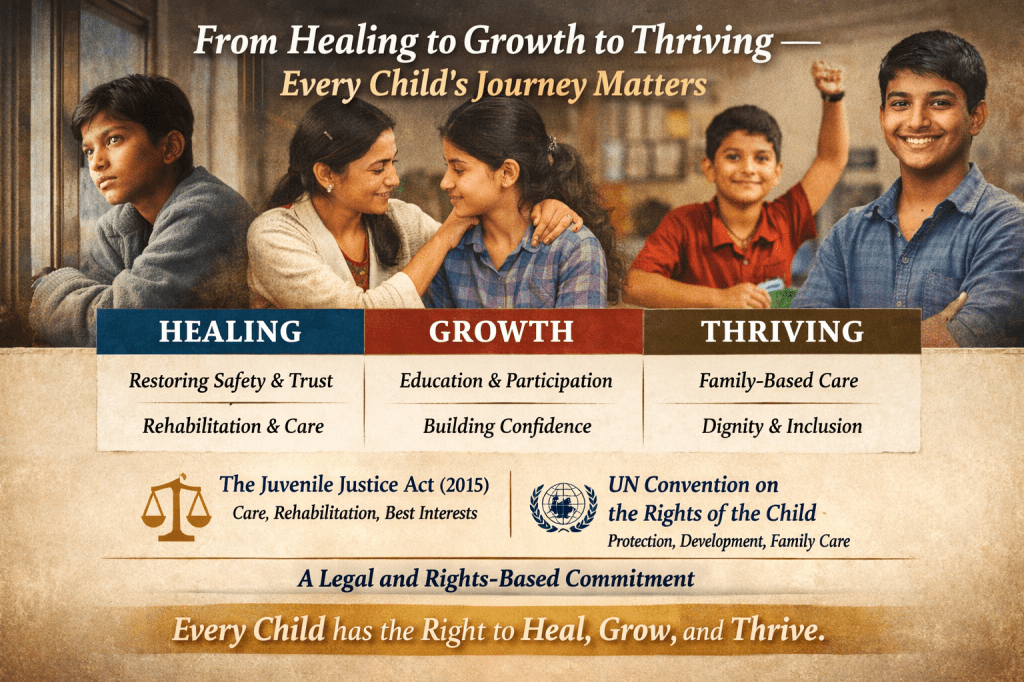
No two children arrive at the same place at the same time. Many carry invisible wounds—grief, fear, and silence shaped by neglect, loss, or trauma. Under the Juvenile Justice (Care and Protection of Children) Act, 2015, such children are recognised as being in need of care and protection, and the law mandates a response rooted in dignity, safety, and their best interests (Section 3).
Healing is the first obligation of the system. The JJ Act emphasises rehabilitation and social reintegration (Section 39), ensuring that children receive care, protection, and stability. This aligns with the United Nations Convention on the Rights of the Child, particularly Article 39, which calls for recovery and reintegration in an environment that fosters health, self-respect, and dignity.
From healing comes growth. The JJ framework promotes development through education, life skills, and participation, while the UNCRC (Articles 12 and 29) affirms a child’s right to be heard and to develop to their fullest potential.
Thriving is the ultimate goal—family-based care, dignity, and inclusion. Both the JJ Act (principle of deinstitutionalisation) and UNCRC (Article 20 and 21) prioritise family environments over institutional care.
Every child’s journey—from healing to growth to thriving—is not charity; it is a legal and moral obligation.
-
Everyday Realities and Quiet Resilience in Child Care Institutions in India
I have visited several child care institutions across the country and have seen a wide spectrum—from well-resourced to modest setups—all striving to serve children in need of care and protection. Not all CCIs receive government grants, yet many continue through community support, individual generosity, and a shared sense of trust that sustains their work.
Across India, these institutions operate in diverse contexts—urban centers, small towns, and remote districts—often facing constraints on staff, infrastructure, and resources. Yet, they respond daily to complex realities: children with no family support, those affected by poverty, neglect, abuse, or loss, and many who require long-term emotional and social rehabilitation.
In these spaces, heartfelt stories unfold every day—of resilience, care, and quiet grace. Caregivers, despite limitations, strive to create a sense of belonging and stability. While not every system functions perfectly, a deep commitment to the best interests of the child continues to guide the work.
There is, perhaps, an unseen strength that sustains these efforts. In that shared space of trust, compassion, and responsibility, true transformation begins—slowly, quietly, but meaningfully—in the lives of children and those who serve them.
-
Meditation for Children: A Quiet Revolution in Schools and Child Care Institutions
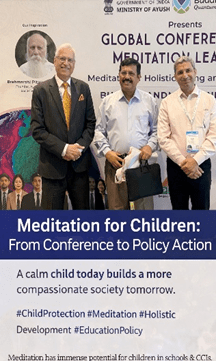
In today’s increasingly complex world, older children—especially those in schools and child care institutions (CCIs)—are navigating stress, emotional challenges, and uncertainty at an early age. We often focus on academic outcomes, but are we equally investing in their inner well-being?
The Global Conference of Meditation Leaders, held recently in New Delhi, offered a compelling vision: integrating meditation into public life as a scientific, inclusive, and scalable tool for holistic living.
For children, the impact can be transformative:
🔹 Improved concentration and learning outcomes
🔹 Better emotional regulation and reduced anxiety
🔹 Enhanced resilience—especially for children in CCIs who may have faced trauma
🔹 Development of empathy, self-awareness, and positive behaviour
Holistic living recognises the deep interconnection between the mind, body, emotions, and environment—something our education and child protection systems must embrace more consciously.If we truly believe every child deserves not just care, but wellbeing—meditation must become part of the system, not an afterthought.
#ChildProtection#Education#MentalHealth#Meditation#HolisticDevelopment#PolicyInnovation -
Openness in adoption
Openness in adoption evolves through a complex interaction of individual experiences, relationships, and the wider system in which adoption takes place. At the individual level, an adoptee’s stage of development, curiosity about identity, and emotional readiness influence the desire for information or contact. Adoptive parents’ sense of security and understanding of the child’s needs, as well as birth parents’ expectations and circumstances, also shape openness.
At the relational level, the quality of interaction between adoptive and birth families is critical. Trust, respectful communication, and clear boundaries can help people connect in meaningful ways. On the other hand, uncertainty or conflict can make it harder for people to get involved. Professional guidance often helps families navigate these relationships constructively.
Beyond these factors, broader social and institutional contexts play a significant role. Cultural attitudes, stigma, and societal understanding of adoption shape perceptions of openness. Legal provisions regarding information sharing, confidentiality, and contact, along with agency practices and counselling support, determine what is feasible.
Openness, therefore, is not a fixed arrangement but a flexible process, continuously shaped by personal needs, evolving relationships, and enabling policy and practice environments.
Personal factors → identity, emotions, readiness
Interpersonal relationships → trust, communication, boundaries
Systemic context → laws, counselling, and social attitudes
 Safe Childhood India